
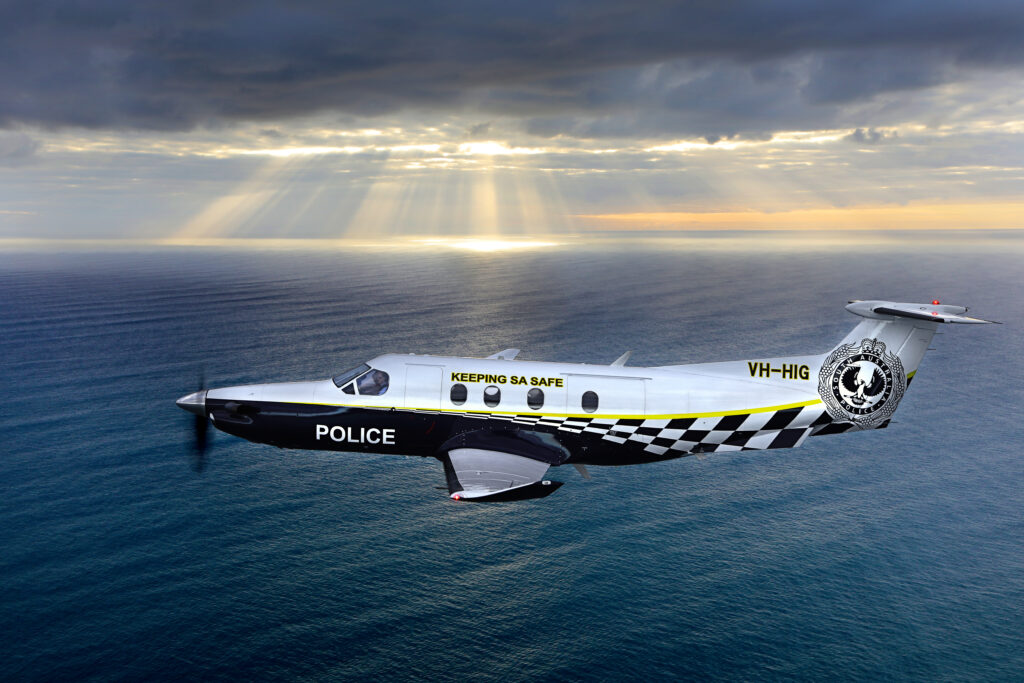
Few aircraft in the world of general and business aviation combine the versatility, reliability, and performance of the Pilatus PC-12. Built in Switzerland and trusted by operators across six continents, the PC-12 has become the aircraft of choice for missions that demand far more than a standard charter flight.
When Pilatus introduced the PC-12, the aviation world took notice, not because it was the fastest or the most luxurious turboprop on the market, but because it was arguably the most adaptable. A single airframe capable of seating up to eight passengers in executive configuration, or reconfigured to carry cargo deep into remote terrain. Decades on, that philosophy of multi-role flexibility remains the PC-12 defining asset.
At Oriens Aviation, we work with operators and buyers evaluating the PC-12 for a wide range of applications. Here, we explore the key special missions this exceptional aircraft supports and why it continues to outperform alternatives in nearly every category.
Pilatus PC-12 Key Performance Figures
- Takeoff distance: 758 m
- Max cruise speed: 290 kts
- Max range 4 pax: 1765 nm
- Passenger capacity: up to 9
Mission 01 – Air Ambulance & Medevac Operations

Perhaps the most compelling of the PC-12 special mission roles is its use as an air ambulance. The large rear cargo door, a defining feature of the airframe, allows patients to be loaded quickly and easily, and an optional lift system further streamlines the process for medical crews working under pressure.
The spacious pressurised cabin of over nine cubic metres can comfortably accommodate up to three patients alongside medical equipment, a capacity that sets the PC-12 apart from most single-engine alternatives in the aeromedical space. Operators running dedicated air ambulance services configure the cabin with oxygen systems, cardiac monitoring equipment, and infusion pumps, all supported by the aircraft’s robust onboard electrical system.
What makes the PC-12 especially valuable for medevac work is its ability to operate from short, unpaved, or remote airstrips. Where jet-powered ambulance aircraft are constrained to longer sealed runways, the PC-12 can operate from grass, gravel, earth, or snow runways with equal composure, reaching communities and facilities inaccessible to virtually any comparable aircraft. For organisations delivering emergency medical services in areas with limited infrastructure, this capability is not merely convenient. It can be life-saving.
The Royal Flying Doctors Service of Central Operations, one of the world’s most demanding aeromedical operators, uses the PC-12 in exactly this role across the Australian outback. As their CEO John Lynch has noted, the aircraft is perfectly tailored to those rigorous conditions, with its versatility, high payload, and quality among the chief reasons so many operators choose it.
Mission 02 – Cargo & Freight Operations

The PC-12 large cargo door transforms the aircraft into a capable freighter without structural modification. The flat cabin floor allows bulky and heavy items to be loaded and unloaded with ease, and the cabin can be reconfigured rapidly to suit different mission requirements — a practical advantage that operators in mixed passenger and freight roles put to daily use.
Several operators worldwide use PC-12 in regular scheduled freight roles, connecting communities on islands or in remote regions where road freight is impractical and jet-powered alternatives uneconomical. In Australia, New Zealand, and across sub-Saharan Africa, PC-12 fleets form the backbone of essential freight services — carrying mail, medical supplies, fresh produce, and spare parts to places that would otherwise go without.
For operators offering both passenger and cargo services, the convertible interior is a genuine commercial advantage. A single aircraft can carry passengers by day and freight by night, without the need for a separate fleet. The efficient conversion process keeps the aircraft productive across all revenue streams.
Mission 03 – Passenger Transport
Thousands of hours flying in harsh environments have proven that the PC-12 versatility, high payload, and excellent quality are among the main reasons why so many civilian organisations and government agencies use it for passenger transport. The nine-seat commuter configuration offers an excellent level of comfort, with a pressurised cabin and the range to serve sectors that would otherwise require a light jet at considerably higher operating cost.
In its executive configuration, the PC-12 is equally capable. With seating for up to eight passengers and a range of 3,339 km, it comfortably handles routes that matter to corporate flight departments and owner-operators alike. The Garmin G3000 Prime avionic suite featuring three high-resolution 14-inch touchscreen displays, brings a level of avionics sophistication previously associated with far more complicated platforms.
Mission 04 – Surveillance

The PC-12 has earned a worldwide reputation as an excellent choice for diverse surveillance missions. Government agencies, border control authorities, coast guards, and defence organisations operate it in Intelligence, Surveillance and Reconnaissance (ISR) roles — drawn by its long endurance, high service ceiling, and significantly lower acquisition and operating costs compared with twin-engine turboprops, jets, or helicopters.
The PC-12 Spectre variant, developed specifically for surveillance and special operations, is equipped with a retractable electro-optical and infrared (EO/IR) sensor system, an integrated utility and jump door, and mission-specific avionics and communication systems. Its ability to loiter quietly at altitude, combined with its rough-field performance, gives it access to operating areas that more expensive platforms simply cannot reach as economically or as flexibly.
Mission 05 – Search and Rescue

The PC-12 multi-purpose door gives it added potential for a wide variety of search and rescue and humanitarian missions. It can be used to drop food parcels and emergency supplies to isolated communities, and its configuration supports parachute operations — enabling rapid deployment of personnel or equipment into areas where landing is not possible.

Combined with the aircraft’s ability to operate from short and unprepared strips at altitude, this makes the PC-12 a natural choice for organisations coordinating disaster response and humanitarian relief in challenging terrain.
Further Roles
Maritime Patrol: Extended endurance and a sensor-ready airframe make the PC-12 a capable offshore patrol platform for fisheries enforcement, search and rescue coordination, and maritime domain awareness.
Humanitarian Aid_ NGOs and relief organisations rely on the aircraft’s rough-field capability to deliver supplies and personnel to disaster-affected regions inaccessible to larger aircraft.
Flight Training: The Garmin G3000 Prime-powered ACE cockpit and docile handling characteristics make the PC-12 an outstanding platform for advanced turboprop and IFR training.
Aerial Survey: Survey operators equip the PC-12 with LiDAR, photogrammetry cameras, and magnetometry equipment for geological survey, infrastructure inspection, and environmental monitoring.
Remote Access: Engineered for short, unpaved strips at altitude, the PC-12 connects remote communities, mining operations, and research stations that are unreachable by conventional transport.
Why the Pilatus PC-12 Works Across All These Roles
The PC-12 multi-mission capability is not accidental. Pilatus designed the aircraft from the outset to serve diverse operating environments, and that philosophy permeates every aspect of the airframe. Three characteristics in particular underpin its versatility.
The large cargo door is perhaps the single most important feature. Rare on any pressurised single-engine aircraft, it enables genuine role flexibility, patients load via the optional lift system, cargo pallets slide directly onto the flat cabin floor, sensor equipment is accessible for maintenance, without the compromises found on aircraft adapted as an afterthought.
The ability to operate from runways with short distances, and from grass, gravel, earth, or snow surfaces, opens access to thousands of airports that other aircraft can only fly over. This is not a marginal advantage in special missions work, it is often the deciding factor in whether a mission can be flown at all.
The Advanced Cockpit Environment, powered by Garmin, brings technology and safety features — including an autoland system, autothrottle, emergency descent mode, and integrated stall warning and protection — that support demanding single-pilot operations across a wide range of environments and mission profiles.
Together, these attributes create an aircraft that has found genuine relevance not just in one or two niches, but across a spectrum of demanding operations. The PC-12 is not merely versatile on paper — it is proven across millions of flight hours in some of the most challenging operational environments on earth.
Conclusion – The Special Mission Standard
In the landscape of single-engine turboprops, the Pilatus PC-12 stands apart. Its combination of range, cabin volume, payload capacity, rough-field performance, and proven reliability makes it the benchmark against which other aircraft in its class are measured.
Whether you are evaluating the PC-12 for an air ambulance operation, a corporate flight department, a government surveillance programme, or a freight service in a challenging environment, the aircraft’s credentials are substantial.
At Oriens Aviation, we work with clients acquiring, managing, and operating PC-12s across a broad range of missions. Our team brings first-hand knowledge of the aircraft’s capabilities and an understanding of how to configure and operate it for maximum effectiveness in your specific role.